

 设为首页
加入收藏
设为首页
加入收藏
教学设计方案Lesson
29
Teaching Aims
1. To train the students’ ability of listening and improve their spoken English.
2. To learn how to make an offer of food.
3. To learn how to use the following useful words and expressions: offer a piece of help oneself to.
4. To get the Ss to know some table manners.
Teaching procedures
Step I Presentation
1.T: We are going to learn some table manners and new words. (Write these on the blackboard).
2. Competition: Write these columns on the Bb.
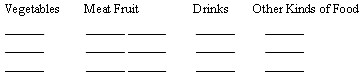
The Ss work in groups. They have to write down the names of as many items of food as they can think of in English. See which group can write down the most items for each category.
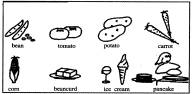
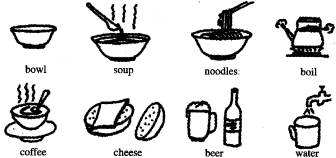
3. Teach the names of food, using some pictures on the projector or the real things. Then ask the Ss what kind of food they like to eat most.
Step 3 Listening
Tell the Ss that we are going to learn a dialogue. In the dialogue Jim and Bob are at Li Jia’s house for dinner.
1. Get the Ss to listen to the tape.
2. After listening, ask the Ss to answer the questions.
3. Get the Ss to listen to the tape again. This time listen and repeat.
Step 4 Reading
Ask the Ss to see how Li Jia offers food to the guests.
T: Please listen to the tape carefully with your books closed. After that, you are to answer some questions.
1) How many kinds of food do the friends talk about in the dialogue? (five)
2) What are they? (beancurd, beef, chicken, pancake, soup)
Step 5 Language study
T allow the Ss enough time to discuss the difficult phrases or sentences. After that, ask some Ss to explain them. If they have any problems, the T explains them.
1) Do you like. . . ? (in general)
Would you like. .. ? (It’s more polite than “Do you want. . .now?”)
2) How about some more beef? (There is no main verb here. This is acceptable in speech, but not usually in written English. )
3) There’ s plenty more. = There’s plenty more beef.
4) Next time you must come to us. = We will invite you to have supper at our house next time.
5) Help yourself to. . . == Please take. . .for yourself.
6) another piece of = one more piece of
Step 6 Practice
1. Get the Ss to read the dialogue in pairs. Then ask some Ss to read it.
2. Do Talking and Oral Practice on Page 29.
3. Watch the video - taped performance of the dialogue.
Step 7 Summary and further practice
1. Summary
Go over the useful words and expressions and ask some Ss to make up sentences.
2. Communicative activities
Allow the Ss enough time to make a similar dialogue using the expressions and structures.
3. Ask one or two pairs to act their dialogues out.
Step 8 Homework
Ask the Ss to finish the exercises on Page 92.
教学设计方案Lesson
30
Teaching aims
1.To train the ability of skimming the text to find the general idea and scanning the text to locate the information quickly.
2. To learn how to use the following words and expressions:
room ,discover, arrive, make into
3. To review the Attributive Clauses.
4. To let the Ss know some farm products.
Step 1 Revision
1. Check the homework in the workbook first.
2. Revise some new words suiting the pictures.
Step2 Presentation
1. Ask the Ss the following questions
1) What’s your favorite food?
2) What food do people like in Shanghai/Sichuan/Tibet/the USA, etc. ?
3) Do you like corn?
Step3.Listening
T play the tape to the Ss, then try to ask them the below.
1) When was corn first brought to China?
2) Can you name some of the plants that were found in America?
Answers: 1)Corn was first brought to China about 450 years ago. 2) For example, beans, potatoes and other different fruits.
Step 4 Reading
T will give the Ss a few minutes to read it, then say something about the useful plant corn.
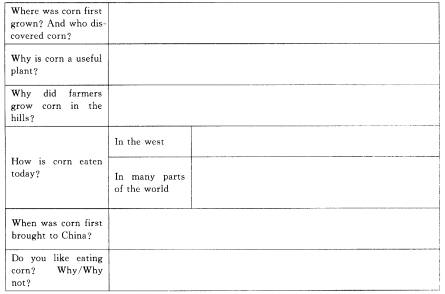
2) Ask the Ss to skim the text to find the general idea.
Answers:
The passage talks about the food in the world. It tells us how corn, tomatoes and other plants were discovered. It mainly tells us how corn was discovered and taken to the other parts of the world and the my of making corn food.
Step 4. Language study
Get the SB to look through the text and explain some language points and difficult sentences, if necessary the T can explain them again.
1) There was not enough room.
2) discovered the tomato
3) an open fire = a fire that bums in the open air
4) got angry = become angry
Step 5Workbook
Get the Ss to do Ex.2 &3 on Page 31 and Ex. 1 &2 on Page 94.
Step 6 Summary and further discussion
1. Retell the text.
2. Discussion:
1) Do you think the agriculture is important?
2) How can you make contributions to the agriculture?
3) What have you learnt from the text?
Step 7 Homework
1. Finish off the exercises in the Wb on Page 93 & 94.
2. Read the text aloud and recite the third paragraph of the text.
 当前位置:
当前位置: